7-Inch vs 10-Inch vs 13-Inch FPV Drones
by SkyVolt FPV Engineering Team · About the authors
- 7 Inch — The All-Rounder
- 10 Inch — The Workhorse
- 13 Inch — The Heavy Lifter
- Decision Shortcut
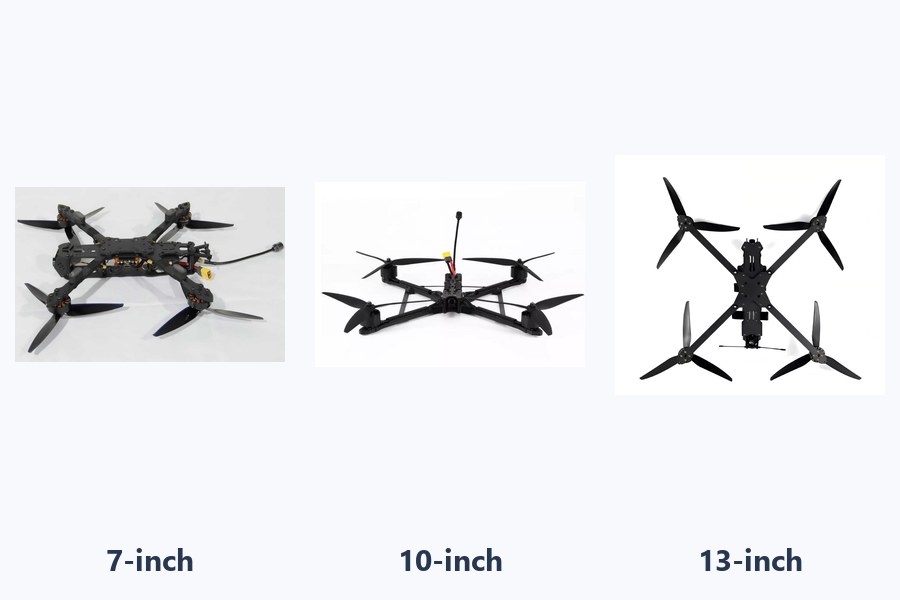
Frame size sets payload, endurance and transportability. Here is how to pick the right class for your mission.
7 Inch — The All-Rounder
A good balance of agility and endurance (15–25 min on Li-ion). A standard build carries a naked action camera or a small sensor, while heavy-lift 7 inch airframes are rated to 2 kg. Best for cinematic follow work, perimeter patrol and general inspection. Typical example: our 7 inch FPV drone with 2 kg payload — the Model-A specification shows the full parts breakdown for that class.
10 Inch — The Workhorse
The industrial standard: 30–50 min endurance, up to 3.5 kg payload, stable in wind. Best for mapping, agricultural scouting, security patrol and delivery trials. See the 10 inch long-range thermal imaging platform, or the AI-ST10 with automatic target tracking if the mission is holding a subject rather than a position — the reasoning is set out in why choose an AI FPV drone.
13 Inch — The Heavy Lifter
For the heaviest sensor packages and near-hour-long endurance. Larger, heavier and with more transport logistics to plan. Best for gimbal and DSLR payloads, heavy sensor packages and long-range pipeline survey — our 13 inch platform carries 4.5 kg, and 15 inch airframes reach 8 kg.
Decision Shortcut
Choose by payload first, endurance second, portability third. Payload capability is the constraint that cannot be tuned later, so start with the numbers in how much payload an FPV drone can carry, then confirm the endurance you actually need against long-range platform selection.
Our team can model your payload on each class before you commit — send the specification and we will return a configuration comparison.