How to Choose a Long-Range FPV Drone
by SkyVolt FPV Engineering Team · About the authors
- Range Is a System, Not a Spec
- Payload Changes the Answer
- Practical Checklist
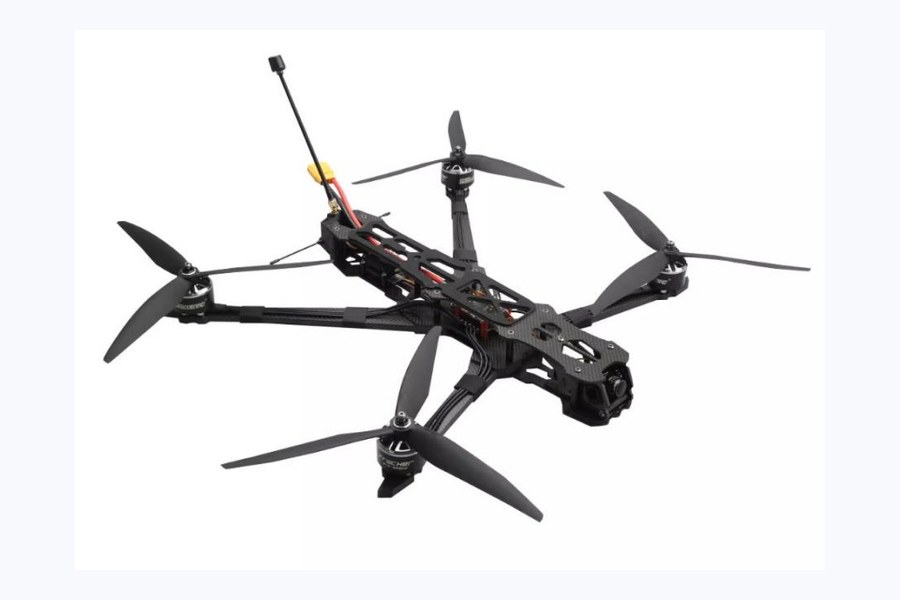
Antenna, power and airframe choices decide whether your FPV platform reaches 10 km or stalls at 3 km.
Range Is a System, Not a Spec
Long-range performance is set by the weakest link in the chain, not by the largest battery. Four areas have to be evaluated together:
- Video link. A 1.6 W VTX with a good directional receive antenna comfortably outperforms an 800 mW unit on a rubber-duck. See our VTX power and range guide.
- Radio link. ELRS 915 MHz or 2.4 GHz with a 500 mW+ TX module keeps RSSI healthy at distance — the trade-offs are covered in ELRS 2.4 GHz vs 915 MHz.
- Airframe efficiency. A 7–10 inch low-drag frame cruising at 60–80 km/h uses far less power per kilometre than a 5 inch racer.
- Battery chemistry. Li-ion packs trade punch for endurance, which suits cruise-heavy missions.
Payload Changes the Answer
Range figures quoted in isolation are misleading: every gram of payload reduces endurance, and endurance is what buys distance. Work out the payload budget before choosing the airframe — the method is in how much payload an FPV drone can carry.
Practical Checklist
Define the real mission before committing to a platform: payload, endurance target and terrain. For most industrial inspection tasks a 10 inch platform with 8S Li-ion, GPS rescue and a 1.6 W VTX is a proven 15 km+ combination — our 10 inch long-range platform is configured along those lines.
Not sure which class fits? Compare the frame sizes in 7-inch vs 10-inch vs 13-inch FPV drones, or send us your mission profile and we will recommend a build.